About This Item
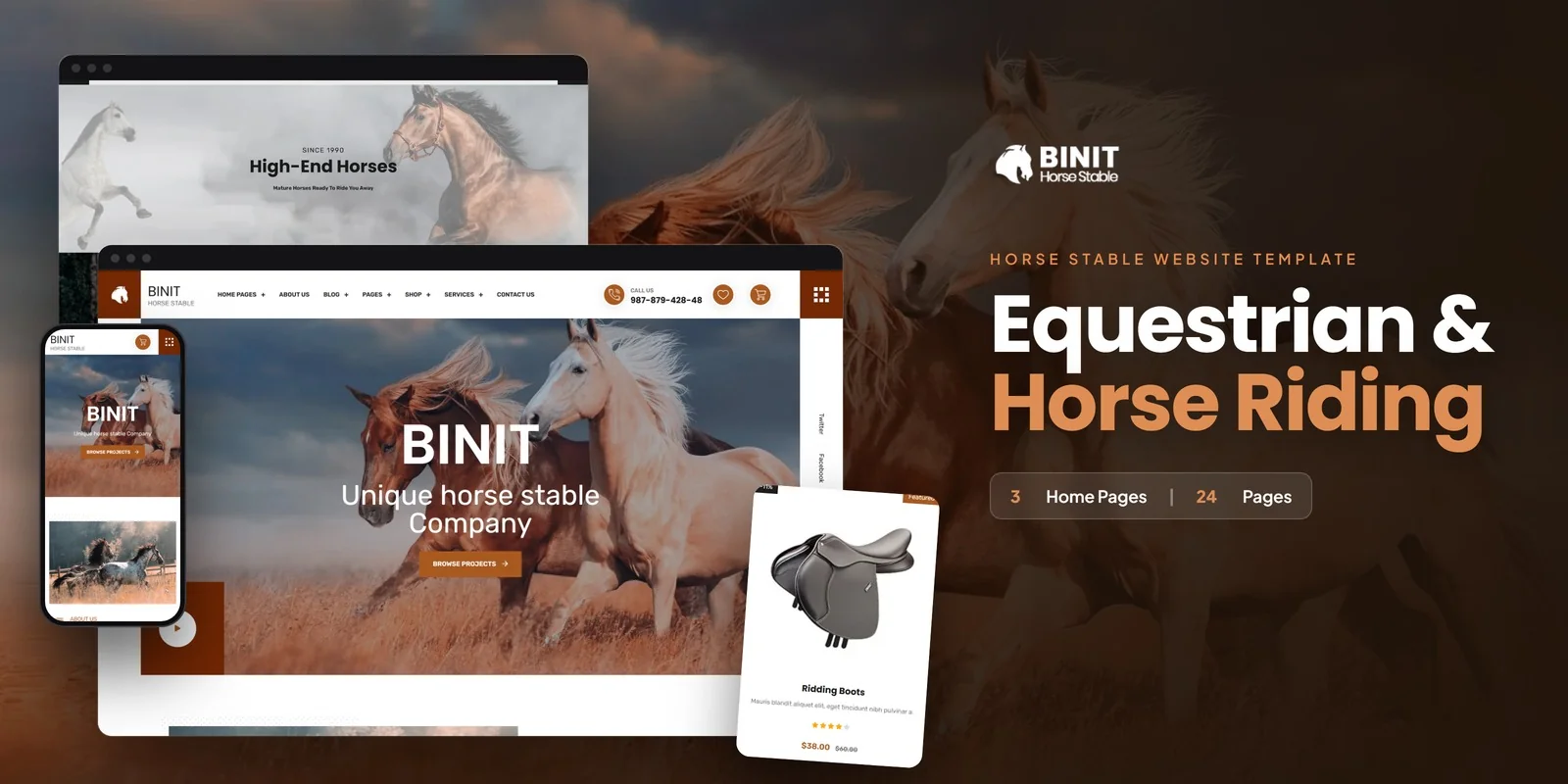
Binit Vue is a feature-rich Horse Riding Stable web application built as a fully functional Vue 3 app using the Composition API, Vite, and Bootstrap 5. It ships with 24+ view components, a filterable horse gallery, a full e-commerce module with cart and checkout, a blog module, written entirely with script setup and the Composition API — zero Options API usage.
Built for Vue developers delivering horse riding stable and equestrian sites and applications. The codebase uses Vue 3 Composition API throughout — ref(), reactive(), computed(), watch(), and composables for shared logic. Single File Components (.vue) keep template, script setup, and scoped styles co-located. Replace the static JSON data sources with any REST API or headless CMS and the reactive layer adapts immediately.
Everything in the Package
- 24+ view-level Single File Components with Vue Router 4 history mode routing
- Vue 3 with script setup syntax and Vite — fast HMR dev server and optimised production build
- Vue Router 4 — history mode with lazy-loaded routes via defineAsyncComponent
- Pinia store for global state management — state, getters, and actions with localStorage persist plugin
- Bootstrap 5 — responsive grid and utility classes
- VeeValidate 4 — schema-based form validation with v-model two-way binding on all booking forms
- Swiper Vue — touch-friendly carousels via SwiperSlide components
- All data sourced from typed JSON in src/data/ — swap to fetch() or axios for live API
- Scoped CSS inside each .vue file — no global style bleed between components
- Retina-ready, fully responsive from 320px to 1920px+
- Vue DevTools compatible — Pinia store fully inspectable in browser
Composition API and Component Architecture
- All views use script setup — defineProps, defineEmits, ref(), computed(), and watch()
- Composables encapsulate reusable logic — useFilter, useCart, useForm, and feature-specific hooks
- Pinia store: defineStore with typed state, computed getters, and async actions
- defineAsyncComponent applied to secondary view bundles — route-level code splitting
- v-model, v-for, v-if, v-show used throughout — idiomatic Vue 3 template syntax
- storeToRefs used for reactive destructuring of Pinia store properties in setup()
- Folder structure: src/views/, src/components/, src/composables/, src/stores/, src/data/
All 24 Views
- /home-v1 — Hero with services strip, horse gallery preview, animated stats, testimonials
- /home-v2 — Alternate hero with featured service spotlight
- /home-v3 — Third home variant with distinct section arrangement
- /about-us — Stable story, mission, and values
- /history — Stable timeline and milestones
- /services — All riding services overview
- /services-2 — Alternate services layout
- /service-details — Full individual service page
- /case-studies — Portfolio of riders and horses
- /case-study — Individual case study detail with results
- /team — Trainer and instructor profiles grid
- /shop-grid — Product archive in grid layout
- /shop-left-sidebar — Product archive with left filter sidebar
- /shop-right-sidebar — Product archive with right filter sidebar
- /shop-detail — Individual product page with zoom
Key Features
- 24 Fully Designed HTML5 Pages across home, services, shop, case studies, blog, and account
- 3 Unique Home Layouts — distinct hero styles and content arrangements
- Bootstrap 5 — responsive, mobile-first grid system
- Full E-Commerce Shop — shop grid, left sidebar, right sidebar, product detail, cart, checkout, wishlist
- Multi-Step Checkout — jQuery Steps powered streamlined booking flow
- Price Range Slider — ion.rangeSlider for filtering lessons and products by price
- Product Zoom View — close-up product image zoom on hover
- Case Studies Module — case studies archive + individual case study detail page
- Services Module — two services overview layouts + individual service detail page
- Team Page — trainer and instructor profiles grid
- History Page — stable timeline and milestone showcase
- Authentication Module — Login and Register pages for account management
- useHead (VueUse) sets per-route title and meta description reactively for SEO
- defineAsyncComponent and Suspense code-split secondary view bundles on route change
- Vite production build applies Rollup tree-shaking, chunk splitting, and asset fingerprinting
- All images carry descriptive :alt bindings meeting WCAG 1.1.1
- Google Fonts loaded with font-display: swap to prevent invisible-text flash
Use Cases
- Horse Riding Stable Businesses: Fast Vue 3 SPA with Composition API — reactive, composable, and easy to maintain
- Vue Developers: Composables, Pinia stores, and Vue Router 4 patterns — production architecture from day one
- Freelancers and Agencies: Deliver a polished horse riding stable site to clients with Vite build tooling and DevTools support
- Startups: Lightweight bundle, defineAsyncComponent code-splitting, and VeeValidate forms ready to go
Credits and Dependencies
- Vue 3 — MIT License
- Vite — MIT License
- Vue Router 4 — MIT License
- Pinia — MIT License
- VeeValidate 4 — MIT License
- Bootstrap 5 — MIT License
- Swiper Vue — MIT License
- Slick — MIT License
- Isotope — MIT License
- WOW — MIT License
- CounterUp — MIT License
- Magnific — MIT License
- Lightbox — MIT License
- jQuery Zoom — MIT License
- Font Awesome 6 — Icons: CC BY 4.0, Fonts: SIL OFL 1.1, Code: MIT
- Google Fonts — SIL Open Font License
- Demo images: Unsplash — Unsplash License (free for commercial use, no attribution required)
- Demo images: Freepik — Freepik License (free for commercial use with attribution)
- All demo images are for preview purposes only and are NOT included in the download.
Changelog
v1.0 2026-03-22
- Vue 3 Composition API with script setup syntax throughout
- Vite build tooling with fast HMR and optimised production output
- 24+ view-level Single File Components with Vue Router 4 history mode
- Pinia store with localStorage persist plugin for global state management
- VeeValidate 4 schema-based form validation on all form views
- defineAsyncComponent route-level code splitting on secondary views
- useHead per-route SEO meta tags via VueUse